
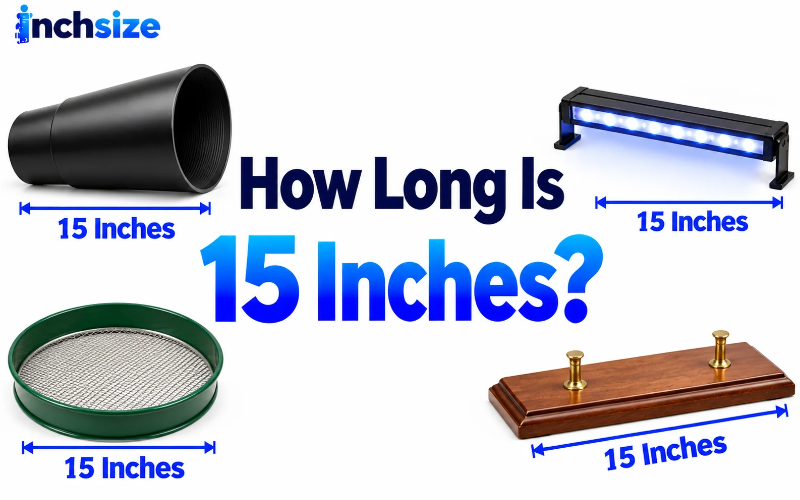
Fifteen inches is exactly 38.1 centimetres, or 381 millimetres. It is also equal to 1 foot and 3 inches, making it 3 inches longer than a standard 12-inch ruler.
A measurement becomes much easier to understand when you can compare it with a real object. For example, 15 inches might describe the length of a narrow equipment rail, the width of a specialist work surface, or the diameter of a circular component.
This guide uses 14 less-common objects to help you picture how long 15 inches really is. The examples come from areas such as astronomy, gardening, printing, musical equipment, and specialist workshops. They are different from the usual laptop, pizza, bowling pin, keyboard, and kitchen comparisons found in many size guides.
You will also learn how 15 inches looks on a ruler, how it compares with human height, and what 15 inches of hair looks like. By the end, you should have a much clearer idea of this measurement in everyday situations.
1 foot and 3 inches long
Start at zero on an inch ruler and measure to the 15-inch mark. If your ruler stops at 12 inches, measure another 3 inches beyond that point.
Imagine a standard 12-inch ruler with another 3 inches added to its end. The total length is 15 inches, or 38.1 centimetres.
How Long Is 15 Inches?
Fifteen inches measures 38.1 cm, which is a little over 38 centimetres. In feet, it equals exactly 1 foot and 3 inches, or 1.25 feet.
Think of a standard 12-inch ruler. If you add another 3 inches to its end, the total distance becomes 15 inches.
This measurement can describe different dimensions depending on the object. A circular object might be 15 inches across its diameter, while a narrow rail could be 15 inches from one end to the other. A flat panel could also be 15 inches wide or tall.
Here are the main conversions:
- 15 inches = 38.1 centimetres
- 15 inches = 381 millimetres
- 15 inches = 1.25 feet
- 15 inches = 1 foot and 3 inches
- 15 inches = 0.381 metres
- 15 inches = approximately 0.4167 yards
The exact conversion is useful when you are checking product dimensions, planning a project, or comparing an object with a space.
How Long Is 15 Inches in CM, MM, and Feet?
You can convert 15 inches into metric measurements by multiplying the number of inches by the correct conversion factor.
One inch is exactly 2.54 centimetres or 25.4 millimetres. Therefore, the calculation is straightforward.
| Measurement unit | Equivalent of 15 inches |
| Inches | 15 in |
| Centimetres | 38.1 cm |
| Millimetres | 381 mm |
| Feet | 1.25 ft |
| Feet and inches | 1 ft 3 in |
| Metres | 0.381 m |
| Yards | 0.4167 yd |
How Long Is 15 Inches in Centimetres?
Fifteen inches equals exactly 38.1 centimetres.
To get this answer, multiply 15 by 2.54:
15 × 2.54 = 38.1 cm.
If you have a metric ruler, look for the 38.1 cm point. It sits just beyond the 38 cm mark.
How Long Is 15 Inches in Millimetres?
Fifteen inches equals 381 millimetres.
There are 25.4 millimetres in one inch. Multiplying 15 by 25.4 gives 381 mm.
This conversion can be useful when working with metal parts, woodworking plans, engineering drawings, or products whose dimensions are listed in millimetres.
How Long Is 15 Inches in Feet?
Fifteen inches equals 1.25 feet, which is the same as 1 foot and 3 inches.
One foot contains 12 inches. After measuring the first 12 inches, you have another 3 inches remaining.
This makes 15 inches a quarter of a foot longer than one foot.
How Long Is 15 Inches in Metres?
Fifteen inches equals exactly 0.381 metres.
To convert inches into metres, multiply by 0.0254:
15 × 0.0254 = 0.381 m.
You can remember this as just over 0.38 metres.
Related Post: 10 Things That Help You See 14 Inches in Real Life
14 Unique Objects That Help You Visualise 15 Inches
The following objects offer different ways to picture a 15-inch measurement. Some are long and narrow, while others are flat or circular.
The dimensions refer to selected or custom-sized examples. They are not claims that every object in each category has a standard 15-inch size.
| Object | Dimension measuring 15 inches |
| Telescope dew shield | Overall length |
| Aquarium LED light bar | Overall length |
| Screen-printing squeegee | Blade width |
| Garden soil sieve | Diameter |
| Model ship display plinth | Overall length |
| Tabletop book press platen | Width |
| Handbell display stand | Height |
| Ceramic slab-roller canvas | Width |
| Beekeeping frame spacer rail | Overall length |
| Photography reflector panel | Width |
| Metalworking V-block base | Overall length |
| Embossing machine guide rail | Overall length |
| Greenhouse ventilation louvre | Width |
| Handcrafted marquetry panel | Overall length |
1. A 15-Inch Telescope Dew Shield
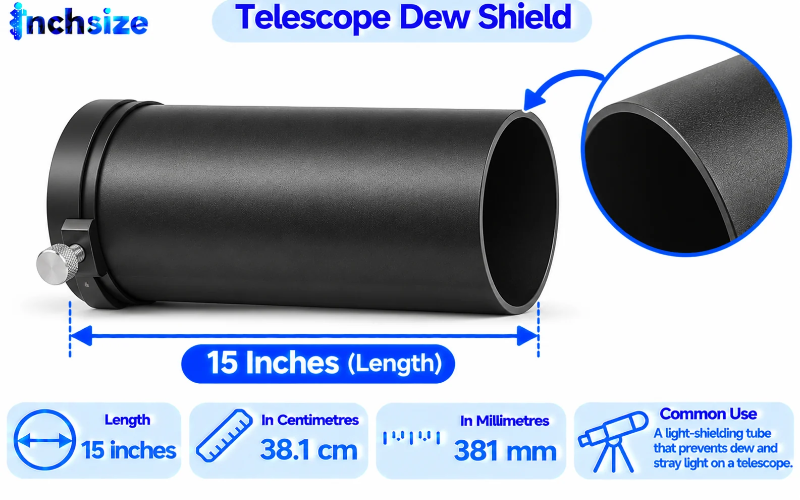
A telescope dew shield is a tube fitted around the front of a telescope. It helps reduce stray light and slows the formation of moisture on the optical surface.
Imagine a custom dew shield measuring 15 inches from its front opening to its rear edge. Place it on a flat surface and measure along its longest side. The distance is 15 inches, or 38.1 cm.
A dew shield is usually shaped like a hollow cylinder. Its length is different from its diameter, which describes the width of the circular opening.
This distinction makes it a useful example when learning how measurements describe different parts of an object. The tube may have a much smaller diameter, but its overall length can still be 15 inches.
Telescope accessories come in many dimensions to fit different optical tubes. A 15-inch dew shield is a selected custom-sized example rather than a universal telescope standard.
2. A 15-Inch Aquarium LED Light Bar
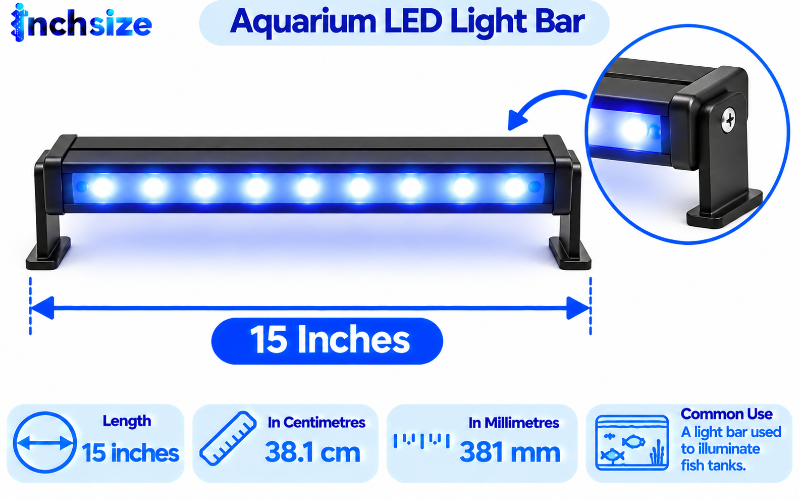
An aquarium LED light bar sits above a fish tank and provides illumination for fish, aquatic plants, and other tank decorations.
For this comparison, picture a light bar with an overall length of 15 inches. Measure from its left end to its right end, including the housing but excluding any separate mounting brackets.
That gives you a straight-line distance of 38.1 cm.
Some aquarium lights are designed to rest on the tank’s edges, while others attach to adjustable supports. Their lengths vary according to the aquarium they are made for.
A 15-inch light bar is a useful visual reference because it is long and narrow. You can imagine it stretching across a small section of a fish tank, just slightly longer than a standard foot-long ruler.
Check the manufacturer’s stated overall length when buying aquarium lighting. The illuminated section and the complete housing may have different measurements.
3. A 15-Inch Screen-Printing Squeegee
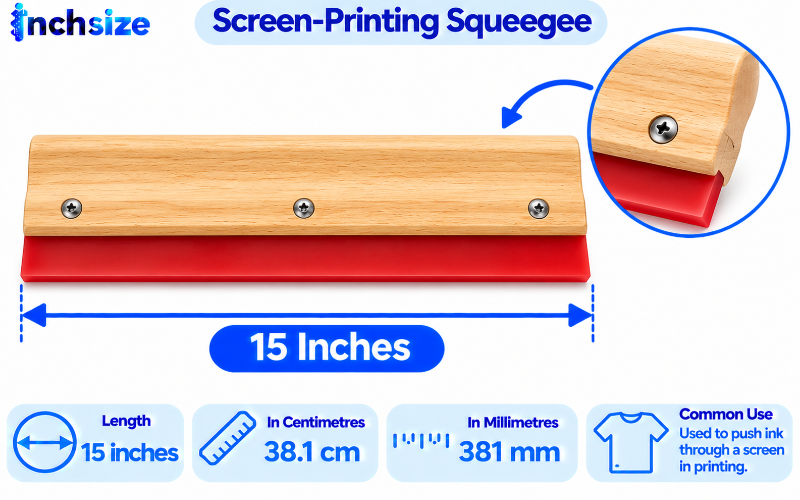
A screen-printing squeegee is a tool used to push ink through a mesh screen and onto a surface. It usually has a handle and a straight rubber blade.
A selected squeegee with a 15-inch blade gives you a clear example of this measurement. Place it horizontally and measure from one end of the rubber blade to the other.
The full blade width is 15 inches, which equals 38.1 cm.
The handle may be shorter or longer than the blade, depending on the design. For this comparison, the measurement refers specifically to the blade rather than the complete tool.
Screen printers use different blade widths for printing on fabric, posters, signs, and other materials. A wider blade can cover more of the screen in one pass.
This example is particularly useful because the straight rubber edge makes the 15-inch measurement easy to identify.
4. A 15-Inch Garden Soil Sieve
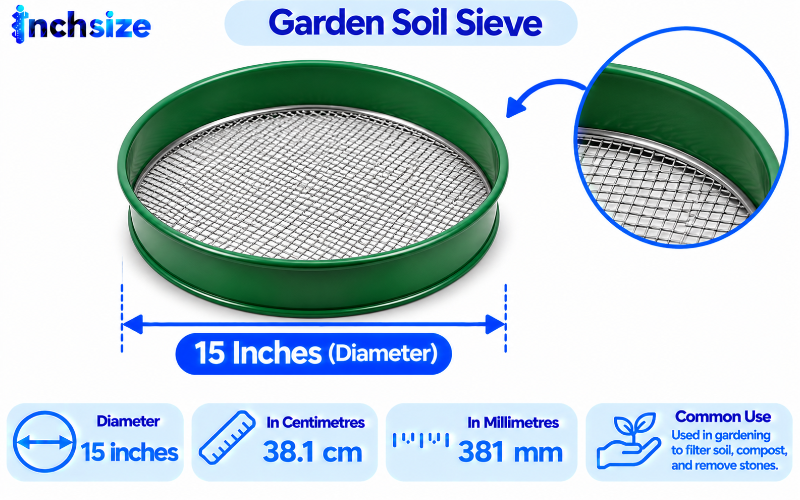
A garden soil sieve is a circular or rectangular frame fitted with mesh. Gardeners use it to separate stones, roots, and larger pieces of material from loose soil or compost.
Imagine a circular sieve with a diameter of 15 inches. Measure straight across its centre from one outside edge to the opposite edge.
That distance is 38.1 cm.
The diameter is not the same as the distance around the frame. The distance around a circular sieve is called its circumference and would be much greater.
A 15-inch sieve gives you a useful comparison because it is wide enough to cover a noticeable area when placed on the ground or over a container.
Garden sieves are sold in different shapes and sizes, so this example refers to a selected 15-inch model. Check whether a product listing gives the frame’s outside diameter or the usable mesh opening.
5. A 15-Inch Model Ship Display Plinth
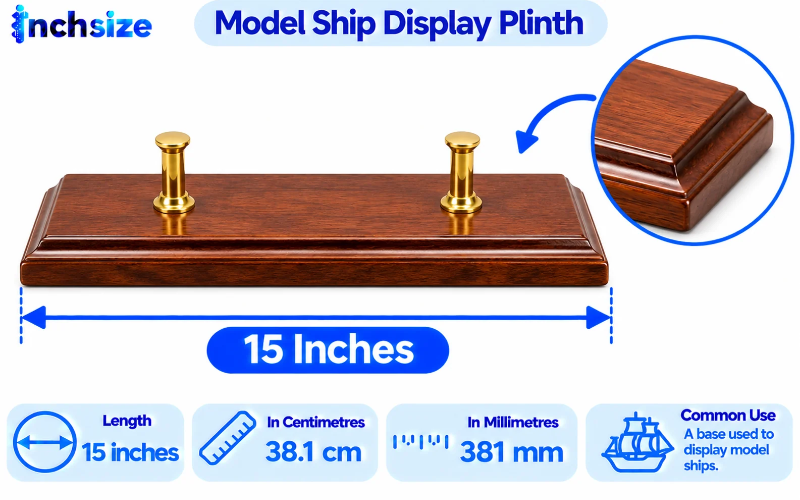
A model ship display plinth is a base used to support and display a miniature sailing ship, yacht, or historical vessel.
For this example, imagine a wooden plinth made to measure 15 inches from end to end. It sits underneath the model and provides a stable surface for its supporting stands.
The overall length is 38.1 cm.
A display plinth is often narrower than the model ship itself, although this depends on the design. The measurement in this example refers only to the base.
Model makers sometimes build custom plinths to match the size and shape of a finished vessel. A 15-inch base is a practical example of a straight object with a clearly defined starting and ending point.
If you are measuring a model ship display, keep the model’s length separate from the base’s length. They are two different measurements.
6. A 15-Inch Tabletop Book Press Platen
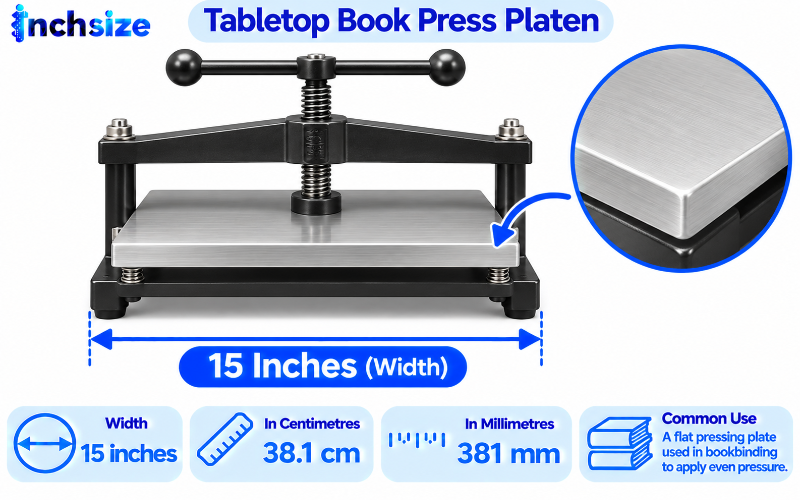
A tabletop book press is a tool used in bookbinding to apply even pressure to books, paper, covers, and other materials. Its flat pressing plates are known as platens.
Imagine a press with a rectangular platen measuring 15 inches across its width. Measure from the left edge to the right edge across the flat pressing surface.
The result is 38.1 cm.
The platen may be longer in the other direction, so its width should not be confused with its total length. Its thickness is another separate dimension.
Bookbinders use presses for jobs such as flattening pages, securing covers, and holding materials while adhesives set. A broad, flat platen helps distribute pressure over the working area.
This example makes 15 inches easier to picture as a width rather than a long, narrow object.
7. A 15-Inch Handbell Display Stand
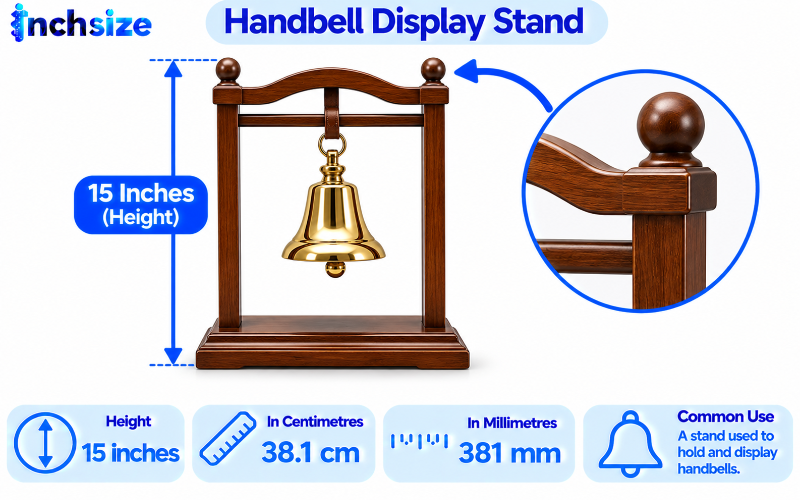
A handbell display stand is a support used to hold one or more handbells when they are not being played. It may have a wooden base, metal supports, or a padded holding section.
For this comparison, picture a display stand that measures 15 inches from its base to its highest point.
That vertical distance is 38.1 cm.
The height may include the base and the upper support, depending on the product’s measurement method. If you are checking a real stand, measure from the surface it rests on to its highest point.
Handbell stands are available in different shapes and sizes. Some hold one bell, while others are designed for a collection.
A 15-inch stand gives you a useful way to understand this measurement vertically. Imagine it standing upright on a table, reaching 38.1 cm above the surface.
8. A 15-Inch Ceramic Slab-Roller Canvas
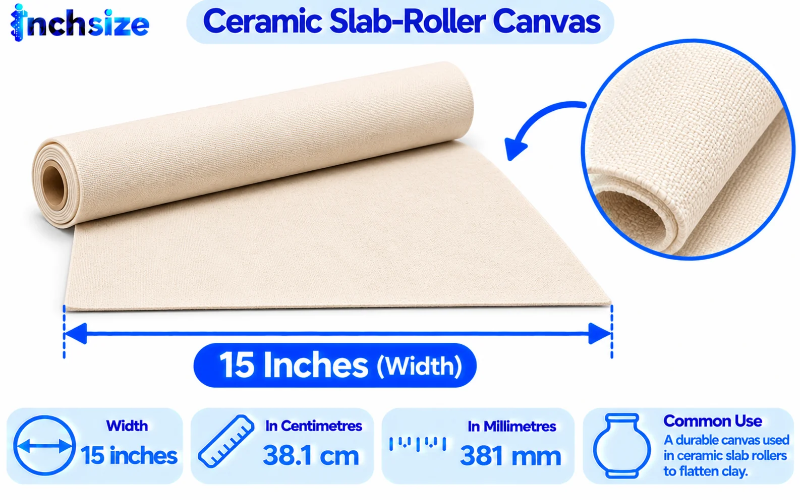
A ceramic slab roller is a tool used by potters to flatten clay into sheets of an even thickness. Some designs use canvas between the clay and the roller to help prevent sticking.
Imagine a rectangular piece of slab-roller canvas measuring 15 inches across its width. Measure from one side edge to the other.
The distance is 38.1 cm.
The canvas may be much longer than it is wide, depending on the slab roller. Its thickness is usually small compared with its width.
Potters use slab rollers to prepare clay for making tiles, decorative panels, plates, and other ceramic pieces. The canvas helps protect the clay surface and makes handling easier.
A 15-inch-wide canvas is a selected example. Actual canvas dimensions should be checked against the working width of the slab roller.
9. A 15-Inch Beekeeping Frame Spacer Rail
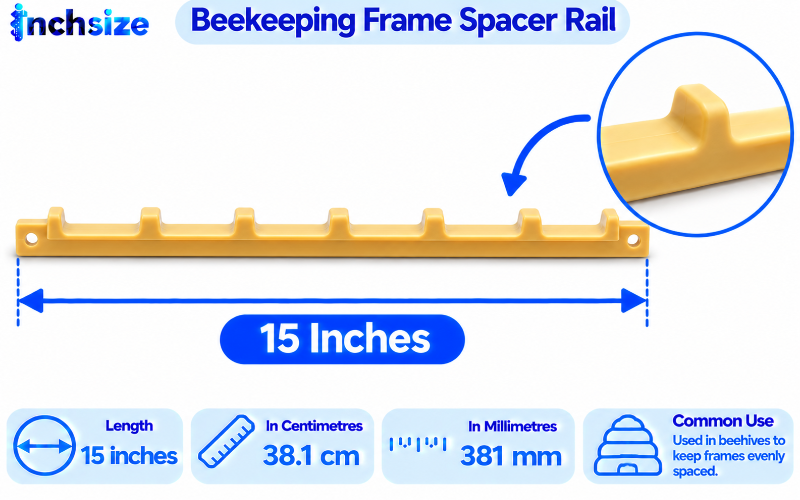
A beekeeping frame spacer rail is a component used to help position or organise frames inside a beehive. Depending on the hive system, the rail may form part of a frame support or a spacing accessory.
For this comparison, picture a straight wooden spacer rail measuring 15 inches from one end to the other.
That is 38.1 cm.
The rail is a narrow piece, so its length is much more noticeable than its width or thickness. You can place it on a workbench and compare it with a standard 12-inch ruler plus another 3 inches.
Beekeeping equipment is made in different dimensions to suit different hive designs. A 15-inch spacer rail should therefore be treated as a selected or custom-sized component, not a universal frame measurement.
When checking hive parts, make sure the rail is compatible with the particular hive system you use.
Related Post: 8 Things That Help You See 12 Inches in Real Life
10. A 15-Inch Photography Reflector Panel
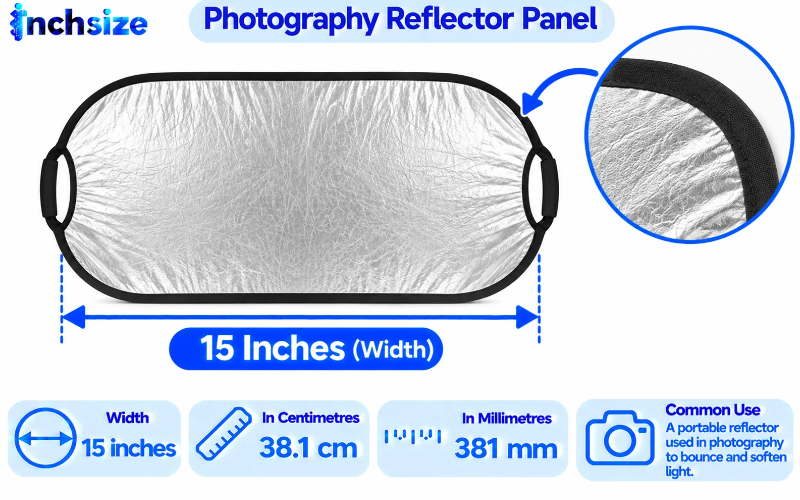
A photography reflector panel is a flat or flexible surface used to bounce light towards a subject. Photographers use reflectors to soften shadows and brighten areas of a photograph.
Imagine a rectangular reflector panel with a width of 15 inches. Measure across its widest horizontal edge from one side to the other.
That gives you 38.1 cm.
The panel may be taller than it is wide, depending on its shape. Some reflectors are circular, while others are rectangular or oval.
A 15-inch-wide panel is a useful reference because it is large enough to see clearly but still small enough to handle easily.
Reflectors are used in portrait photography, product photography, and small studio setups. Their dimensions vary, so always check the actual width rather than relying on the product name.
11. A 15-Inch Metalworking V-Block Base
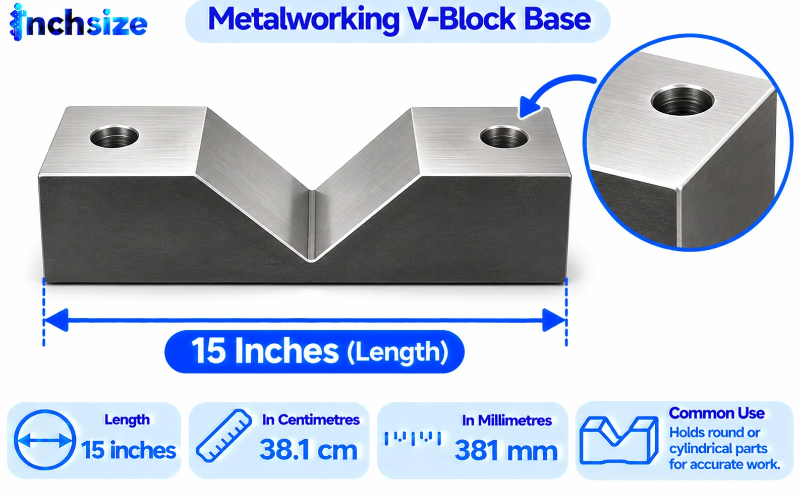
A V-block is a workshop tool used to hold round objects, such as rods or shafts, while they are measured, marked, drilled, or machined.
Some V-blocks are small enough to hold in one hand. Larger workshop fixtures can have much longer bases.
For this comparison, imagine a custom metalworking V-block assembly with a base measuring 15 inches from end to end.
The overall base length is 38.1 cm.
The V-shaped groove is a separate feature. It holds the round workpiece, but it does not determine the length of the base.
This example helps show that 15 inches can describe the overall length of a solid metal workshop component. It also provides a useful comparison for people who work with machinery or precision parts.
Industrial fixtures are made in many sizes, so this is a custom-sized example rather than a standard dimension for all V-blocks.
12. A 15-Inch Embossing Machine Guide Rail
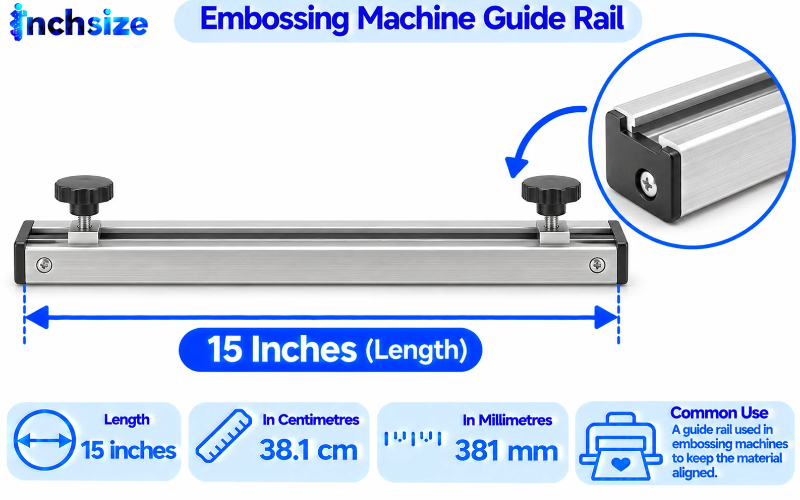
An embossing machine guide rail helps position material as it passes through a machine. It can be used in craft, printing, packaging, and other processes where material needs to follow a controlled path.
Imagine a straight guide rail measuring 15 inches from one end to the other. That is 38.1 cm.
The rail may be made from aluminium, steel, or another rigid material. Its height and thickness are smaller measurements and should not be confused with its overall length.
A guide rail provides a useful comparison because its straight edges make the full distance easy to visualise. Place it beside a 12-inch ruler and you will see that it extends another 3 inches beyond the ruler’s end.
Guide rails vary according to the machine they fit. A 15-inch rail is a selected example, not a universal embossing machine specification.
13. A 15-Inch Greenhouse Ventilation Louvre
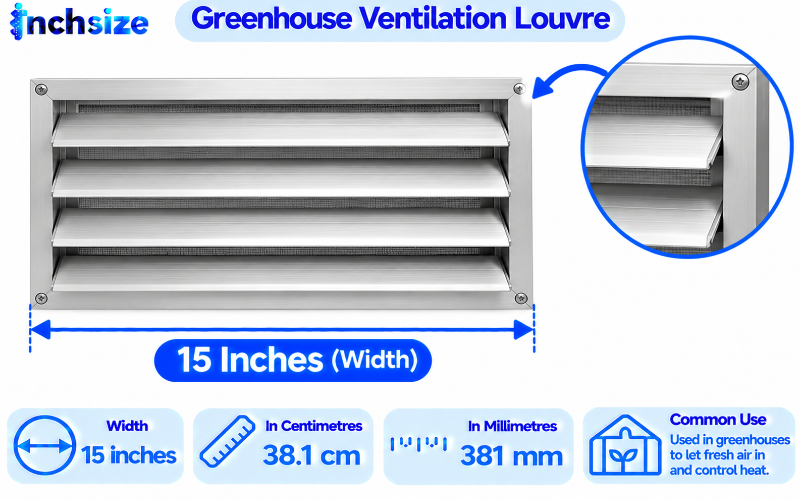
A greenhouse ventilation louvre is a framed opening with angled slats that allow fresh air to move through a greenhouse. It can help control temperature and reduce excess humidity.
For this comparison, imagine a rectangular louvre unit measuring 15 inches across its width.
The distance from one outside side of the frame to the other is 38.1 cm.
The slats inside the frame may be much shorter than 15 inches. The measurement refers to the complete frame width, not the size of an individual slat.
Greenhouse louvres come in different dimensions depending on the structure and ventilation requirements. Some are installed in side walls, while others are fitted into roof sections.
This example is useful because it shows how a 15-inch measurement can describe the width of a functional building component.
14. A 15-Inch Handcrafted Marquetry Panel
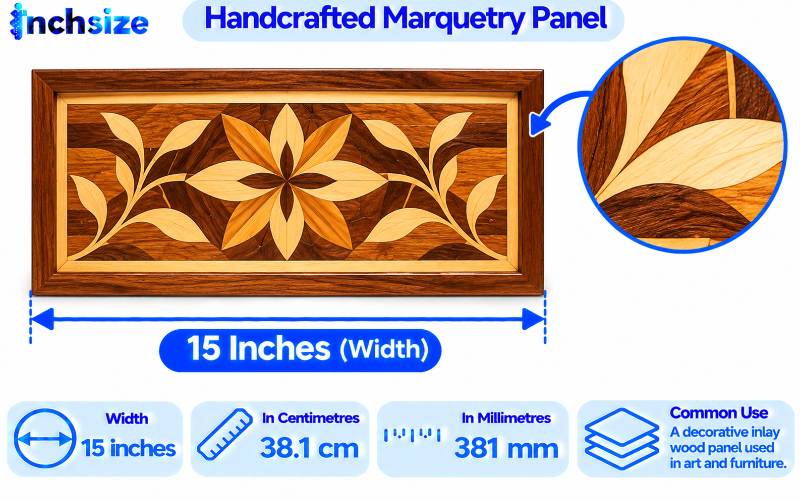
Marquetry is a decorative craft in which small pieces of wood veneer are arranged to create patterns or pictures. The finished work may be used on furniture, decorative boxes, wall panels, or other surfaces.
Imagine a rectangular marquetry panel measuring 15 inches along its longest edge. Measure from one end to the other across the finished panel.
That distance is 38.1 cm.
The panel may contain many small pieces of wood, but the overall length is measured across the complete outside edge. Its width and thickness are separate dimensions.
A 15-inch panel gives you a useful visual reference because it combines a clear straight-line measurement with a detailed surface.
Marquetry panels are often made to suit a particular project, so their dimensions can vary. This example refers to a custom panel made to a 15-inch length.
How Long Is 15 Inches on a Ruler?
On an inch ruler, 15 inches is the distance from the zero mark to the 15-inch mark.
However, many standard rulers stop at 12 inches. If yours does, you can measure 15 inches in two stages.
- Place the ruler on a flat surface.
- Line up the zero mark with your starting point.
- Measure to the 12-inch mark.
- Keep the ruler aligned and continue another 3 inches.
- The complete distance is 15 inches.
If you have a longer ruler or a tape measure, you can measure the full distance in one go.
On a metric ruler, look for 38.1 cm. This is the same length as 15 inches.
Always use the zero marking rather than the physical edge of the ruler. Some rulers have a small gap before the first measurement line.
How Long Is 15 Inches Visually?
To picture 15 inches without looking at a conversion chart, imagine a 12-inch ruler with another 3 inches added to one end.
You can also picture a straight object measuring just over 38 centimetres. It is longer than a standard foot, but still short enough to fit comfortably across many small work surfaces.
The 14 objects in this guide offer different visual references:
- A telescope dew shield shows a long, hollow tube.
- An aquarium light bar shows a narrow horizontal object.
- A garden soil sieve shows a circular diameter.
- A book press platen shows a flat surface width.
- A handbell stand shows a vertical height.
- A metalworking fixture shows a solid workshop component.
Looking at different shapes helps you understand that the same 15-inch distance can appear in several ways.
How Long Is 15 Inches in Height?
A height of 15 inches means the vertical distance from the bottom of an object to its top is 38.1 cm.
For example, imagine a small display stand resting on a table. If its highest point reaches 15 inches above the tabletop, its height is 15 inches.
To measure this accurately, place the measuring tool vertically alongside the object. Start at the bottom and read the measurement at the top.
Height is different from length or width. A rectangular panel could be 15 inches wide but only 8 inches tall.
Always check which dimension a product listing describes before deciding whether it will fit a particular space.
How Long Is 15 Inches in Width?
A width of 15 inches means an object measures 38.1 cm from one side to the other.
For example, a rectangular photography reflector panel could be 15 inches wide while being taller in the other direction.
A circular object uses a different term. If it measures 15 inches from one outside edge to the opposite edge through its centre, that measurement is its diameter.
Width, length, height, and diameter can all describe a 15-inch measurement, but they refer to different directions or features.
How Long Is 15 Inches of Hair?
Fifteen inches of hair measures 38.1 cm when the strand is measured from near the roots to its ends.
The way it looks when worn depends on the person’s height, hairstyle, hair texture, and the point where the measurement begins.
Straight hair usually hangs closer to its full measured length. Wavy and curly hair can look shorter because the strands bend and form curls.
If you want to measure your own hair, take a section and measure from the root area to the tips. Keep the strand straight without pulling it too tightly.
A 15-inch hair length is often considered a medium-to-long hairstyle, but its visible position on the body varies from person to person.
How Long Is 15 Inches Compared to a Human?
Fifteen inches is a relatively small part of an adult’s total height.
For a simple mathematical comparison, imagine a person who is 5 feet tall. That height equals 60 inches, so 15 inches represents one-quarter of their total height.
This is a proportion comparison, not a claim that a particular body part measures 15 inches. Human proportions vary, and you should not use an average body measurement as an exact ruler.
For a more reliable visual reference, compare 15 inches with a measured object or a tape measure.
How Long Is 15 cm Compared with 15 Inches?
Fifteen centimetres and 15 inches are very different lengths.
- 15 inches = 38.1 cm
- 15 cm = approximately 5.91 inches
This means 15 inches is more than twice as long as 15 centimetres.
If you place the two measurements side by side, the 15-inch distance extends much farther. The difference is 23.1 cm.
Be careful when reading product dimensions because inches and centimetres use different scales. A measurement of 15 cm is not the same as 15 inches.
How to Estimate 15 Inches Without a Ruler
If you do not have a ruler nearby, you can still make a rough estimate.
Start with one foot. A foot is 12 inches. Add another 3 inches to picture the complete 15-inch distance.
Use a marked string. If you have a tape measure available, mark a piece of string at 15 inches. You can keep it as a quick reference for later.
Use a metric tape measure. Find the 38.1 cm point. It represents exactly the same length.
Compare with a selected object. A custom 15-inch light bar or a 15-inch model ship plinth can help you visualise the distance.
These methods are suitable for estimating. If you are cutting material, fitting equipment, or buying something that must fit a specific space, use a proper measuring tool.
Related Post: 12 Things That Help You See 13 Inches in Real Life
FAQs
How long is 15 inches in centimetres?
Fifteen inches equals exactly 38.1 centimetres.
How many millimetres are in 15 inches?
Fifteen inches equals 381 millimetres.
How many feet is 15 inches?
Fifteen inches equals 1.25 feet, or 1 foot and 3 inches.
What is 15 inches in metres?
Fifteen inches equals 0.381 metres.
What object is 15 inches long?
A custom-sized telescope dew shield, aquarium LED light bar, or model ship display plinth can measure 15 inches. A garden soil sieve can also have a 15-inch diameter.
How long is 15 inches on a ruler?
It is the distance from the zero mark to the 15-inch mark. If your ruler stops at 12 inches, measure another 3 inches beyond that point.
Is 15 inches longer than a foot?
Yes. A foot is 12 inches, so 15 inches is 3 inches longer.
How long is 15 inches of hair?
Fifteen inches of hair measures 38.1 cm along the strand. Its visible length depends on the hair’s texture, curl pattern, and the person’s proportions.
How long is 15 inches compared with a human?
For a person who is 5 feet tall, 15 inches represents one-quarter of their total height. This is a mathematical comparison rather than a fixed body measurement.
Is 15 cm the same as 15 inches?
No. Fifteen centimetres equals approximately 5.91 inches. Fifteen inches equals 38.1 centimetres.
How much longer is 15 inches than 12 inches?
Fifteen inches is exactly 3 inches longer than 12 inches. The difference is 7.62 centimetres.
Conclusion
Fifteen inches measures exactly 38.1 cm or 381 mm. It is also 1 foot and 3 inches, making it slightly longer than a standard 12-inch ruler.
The 14 objects in this guide show how the same distance can describe the length of a telescope accessory, the width of a printing tool, the diameter of a garden sieve, or the height of a display stand.
When comparing measurements, remember to check which dimension is being described. Length, width, height, and diameter are not interchangeable.
Once you understand the difference, it becomes much easier to picture 15 inches and recognise this measurement when you see it in real life.