
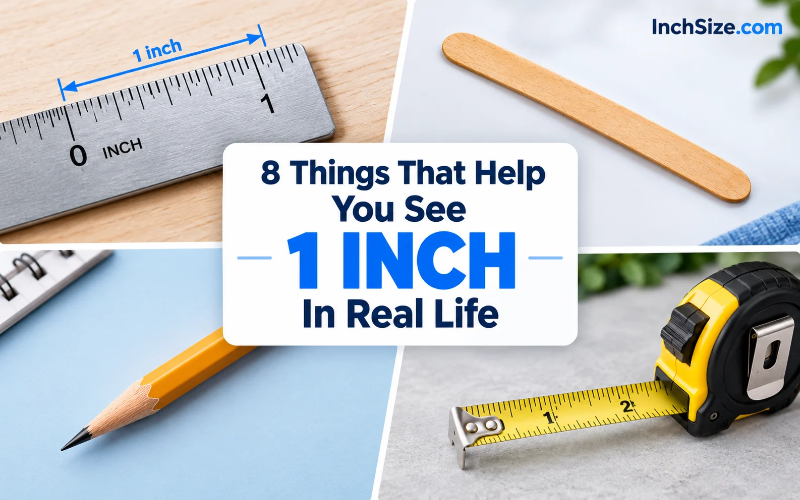
One inch is a small length, but it appears in many everyday measurements. You may need to understand it when measuring a small object, checking a product’s size, working on a DIY project, or trimming something to a specific length. Knowing what one inch looks like can help you estimate sizes even when a ruler is not nearby.
The easiest way to understand an inch is to connect it with a familiar object or a clearly measured part. However, not every small object is exactly one inch long. Some examples provide a visual comparison, while others can be measured to show the precise distance.
How long is an inch?
One inch equals exactly 25.4 millimeters.
What does one inch look like?
One inch is a short length of 2.54 centimeters. To see it accurately, measure from the zero mark to the 1-inch mark on a ruler. Everyday objects and finger widths can help you estimate the length, but their dimensions vary.
How Long Is 1 Inch?
One inch equals 2.54 centimeters or 25.4 millimeters. It is a standard unit of length in the imperial and US customary measurement systems.
For example, if you mark a starting point on a piece of paper and measure 2.54 centimeters from it, the distance between the two marks is exactly one inch.
Here are the basic conversions:
| Measurement Unit | Equivalent to 1 Inch |
| Inches | 1 inch |
| Centimeters | 2.54 cm |
| Millimeters | 25.4 mm |
| Feet | 0.0833 feet |
| Meters | 0.0254 m |
These conversions make it easier to understand product dimensions and compare measurements written in different units. If a product description lists a part as 1 inch long, you can picture a length of 2.54 centimeters.
Related Post: How long is 2 Inches
How Many Centimeters and Millimeters Are in One Inch?
One inch equals 2.54 centimeters, or 25.4 millimeters. Since one centimeter contains 10 millimeters, you can convert between these units using simple multiplication or division.
For example:
- Inches to centimeters: Multiply the inch measurement by 2.54.
- Inches to millimeters: Multiply the inch measurement by 25.4.
- Centimeters to inches: Divide the centimeter measurement by 2.54.
- Millimeters to inches: Divide the millimeter measurement by 25.4.
If you want to know how long an inch is in centimeters, remember that 2.54 cm is the exact equivalent. A centimeter is shorter than an inch, so one inch is slightly more than two and a half centimeters.
This difference matters when measuring small objects. A measurement of 2 cm is not a full inch, and a measurement of 3 cm is slightly longer than one inch.
Related Post: How Long is 3 Inches?
How to Visualize One Inch Without a Ruler
You can estimate one inch by comparing a length with familiar objects, but the accuracy depends on the object you choose. A person’s finger width, for example, may be close to an inch for one person and noticeably different for another.
For a more dependable comparison, look for an object or component with a published dimension of exactly one inch. You can also use a phone’s calculator to convert measurements, although the screen itself is not automatically a reliable physical ruler.
Here are three practical methods:
- Use a measured reference: Find an object whose relevant dimension is documented as 1 inch.
- Compare centimeters: Picture a straight length of 2.54 cm.
- Check a ruler: Locate the zero mark and measure to the first inch mark.
A familiar object can help you estimate the length, but a ruler or measuring tape is the better choice when accuracy matters.
Table of 8 Real-Life Objects That Help You Visualize One Inch
The following table separates reliable measurement references from objects whose sizes can vary. The examples are useful starting points, but a product’s exact dimensions should be checked before treating it as a one-inch reference.
| Object or Reference | Part to Measure | Relationship to 1 Inch |
| Inch ruler | Distance from zero to the 1-inch mark | Exactly 1 inch |
| Metric ruler | Distance of 2.54 cm from zero | Exactly 1 inch |
| Measuring tape | One-inch interval between markings | Exactly 1 inch |
| Printable one-inch square | One side of the square, printed at actual size | Exactly 1 inch when printed correctly |
| Wooden craft stick | Width or length of a selected part | Depends on the stick’s dimensions |
| Standard playing card | Short edge or long edge | Neither edge should be assumed to be 1 inch |
| Pencil | Width or diameter of the pencil | Varies by pencil design |
| Finger | Width across a selected finger | Varies by person |
1. Inch Ruler

An inch ruler is one of the clearest ways to understand how long an inch is. The distance from the zero mark to the one-inch mark represents exactly one inch, regardless of the ruler’s overall length.
To measure correctly, place the starting edge of the item at zero. Then check where the other edge reaches the scale. Avoid starting at the physical end of a ruler if the zero mark is slightly set in from the edge.
The smaller marks between the inch numbers represent fractions of an inch. Depending on the ruler, they may show half-inch, quarter-inch, eighth-inch, or sixteenth-inch divisions.
This is a reliable reference because the measurement is marked directly on the tool rather than estimated from the object’s appearance.
2. Metric Ruler

A metric ruler provides another way to see one inch. Because one inch equals 2.54 centimeters, you can measure a distance of 2.54 cm to reproduce exactly one inch.
On a metric ruler, each centimeter is divided into 10 millimeters. The one-inch distance therefore covers 25.4 millimeters, which falls between the 25 mm and 26 mm marks.
This is a useful detail to remember when a ruler has only metric markings. Measuring 2.5 cm gives you 25 mm, which is very close to one inch but is actually 0.4 mm shorter.
For everyday estimating, the difference is small. For precise work, use the full 2.54 cm conversion.
3. Measuring Tape

A measuring tape is useful when you need to measure longer objects as well as short distances. Many measuring tapes include inch markings, and the interval between the zero mark and the one-inch mark gives you a direct reference.
Look at the markings carefully before measuring. Some tapes display inches on one side and centimeters on the other. Choose the scale you need and keep the tape straight against the surface.
The tape’s flexibility makes it convenient for measuring furniture, fabric, packages, and household spaces. However, it should be held flat and reasonably taut so that the measurement does not shift.
If you are learning how long an inch is, focus on a single interval between adjacent inch numbers rather than the entire tape.
4. Printable One-Inch Square

A square with sides measuring exactly one inch can provide a useful visual reference. Each side should measure 1 inch, while the diagonal is longer than one inch.
You can create a square in a document or drawing program and print it at actual size. Before using it, measure one side with a ruler to make sure the printer did not scale the design.
Printer settings such as “Fit to page” can change the size of a shape. Select actual size or 100% scaling when available, and verify the result after printing.
This example is especially helpful for crafts, school projects, and small DIY tasks because it gives you both a length and a visible area to compare.
5. Wooden Craft Stick

Wooden craft sticks are common in school projects, art activities, and home crafts. They can help you visualize small measurements, but their dimensions depend on the type of stick.
Some craft sticks are long and narrow, while others are wider or designed for specific projects. Do not assume that the stick’s width or any section of its length is exactly one inch without measuring it.
For a practical comparison, place a ruler beside the stick and identify a one-inch section. You can then compare that marked distance with the stick’s width or use it to mark a cutting or gluing position.
The important point is to use the stick as a reference only after checking its actual dimensions.
6. Standard Playing Card

A standard playing card is a familiar household object, but it is not a one-inch reference by itself. Its width and length are several inches, and exact dimensions can vary by card type and manufacturer.
You can still use a card to practice estimating a one-inch distance. Place a ruler along one edge and identify the first inch from the corner. That marked segment is much shorter than the full card edge.
This comparison can help you understand the difference between a small unit and a larger object. It also shows why checking dimensions is important: an object can be useful for visualizing a measurement without being exactly that size.
7. Pencil

A pencil is easy to find at home, school, or work. Its overall length is much greater than one inch, and the thickness of the pencil depends on its design.
A standard wooden pencil should not be treated as exactly one inch wide. Instead, use it to practice identifying a one-inch segment along its length. Mark the starting point, measure one inch with a ruler, and compare the segment with the rest of the pencil.
This exercise makes it easier to recognize how short one inch is relative to an everyday item. It also helps build a better sense of scale when measuring stationery or other small supplies.
8. Finger Width

Your finger can provide a quick visual estimate of one inch, but it is not a standardized measuring tool. Finger width varies with hand size, age, and individual anatomy.
For one person, the width across a finger may be close to an inch. For someone else, it may be narrower or wider. You should therefore avoid assuming that your finger measures exactly one inch.
To check your own hand, place a ruler across the finger at the point you want to compare. This will show whether that particular width is close to 2.54 cm.
Your finger can be a convenient rough reference when a ruler is unavailable, but use a proper measuring tool for accurate results.
Related Post: How long is 4 inches?
How to Measure One Inch Accurately
The most reliable way to measure one inch is with a ruler or measuring tape that has inch markings. Follow these steps:
- Place the ruler beside the item you want to measure.
- Align the item’s starting edge with the zero mark.
- Find the one-inch mark.
- Check whether the item’s other edge reaches that mark.
- Keep the ruler straight and read the markings at eye level.
If your ruler uses centimeters, measure 2.54 cm instead. Avoid rounding the conversion to 2.5 cm when the exact measurement is important.
For a small object, check that the ruler’s edge does not cover the point you need to measure. If necessary, mark the endpoints lightly with a pencil and measure the distance between them.
Related Post: How Long is 8 Inches
Is One Inch the Same as a Finger Width?
No. One inch is a fixed unit equal to 2.54 cm, while finger width varies from person to person. Your finger might be close to one inch wide, but it should not be used as an exact measurement unless you have checked it.
The same principle applies to other body-based estimates. Hand spans, thumb widths, and finger lengths differ, so they can help with rough comparisons but cannot replace a ruler when precision matters.
FAQs
How long is one inch in centimeters?
One inch is exactly 2.54 centimeters. To convert inches into centimeters, multiply the inch measurement by 2.54. This conversion is useful for understanding product sizes and comparing measurements in metric units.
How many millimeters are in an inch?
One inch equals 25.4 millimeters. Since one centimeter contains 10 millimeters, 2.54 centimeters also equals 25.4 millimeters.
What does one inch look like in real life?
One inch looks like a short straight distance of 2.54 cm. A ruler, measuring tape, or correctly printed one-inch square provides a more dependable visual reference than an object whose dimensions vary.
Is one inch the same as a finger width?
No. A finger may be close to one inch wide, but finger sizes vary. Measure your own finger with a ruler if you want to know how its width compares with 2.54 cm.
How can I measure one inch without a ruler?
You can use a measuring tape with inch markings or a correctly printed one-inch reference that has been checked for size. Without a measuring tool, familiar objects can provide only rough estimates.
How long is an inch and a half?
An inch and a half is 1.5 inches, equal to 3.81 centimeters or 38.1 millimeters. It is half an inch longer than a single inch.
How long is an inch and a quarter?
An inch and a quarter is 1.25 inches, equal to 3.175 centimeters or 31.75 millimeters. It is one quarter of an inch longer than one inch.
Can I measure one inch accurately on a phone screen?
Not automatically. Screen size, display scaling, and device settings affect the physical length shown on a screen. Use a calibrated ruler application only if it has been checked against a real ruler.
How long is an inch of hair?
One inch of hair growth equals 2.54 centimeters when measured as a straight length. Curly or coiled hair can look shorter because of its natural shape, so appearance alone may not show its full length.
How long is an inch compared to a centimeter?
One inch equals 2.54 centimeters, so it is longer than two centimeters but shorter than three centimeters. The difference between one inch and one centimeter is 1.54 centimeters.
Conclusion
One inch is a fixed measurement of 2.54 centimeters or 25.4 millimeters. Everyday objects can help you develop a sense of its size, but their dimensions should not be assumed to match one inch.
For reliable results, use a ruler, measuring tape, or verified one-inch reference. Once you become familiar with this small unit, it becomes easier to estimate dimensions and understand measurements in daily tasks.
5 thoughts on “8 Things That Help You See 1 Inch in Real Life”